English
  ไทย
ไทย 

Choosing the best OTP delivery channel is critical for businesses that rely on secure authentication. Whether you operate in banking, fintech, e-commerce, insurance, or enterprise SaaS, your OTP infrastructure directly impacts security, user experience, and conversion rate.
If you’re searching for a reliable authentication infrastructure, a strong cloud messaging architecture like this 👉 secure OTP gateway solution can significantly improve performance and deliverability.
Let’s break down the three main OTP channels.
1️⃣ SMS OTP – The Industry Standard
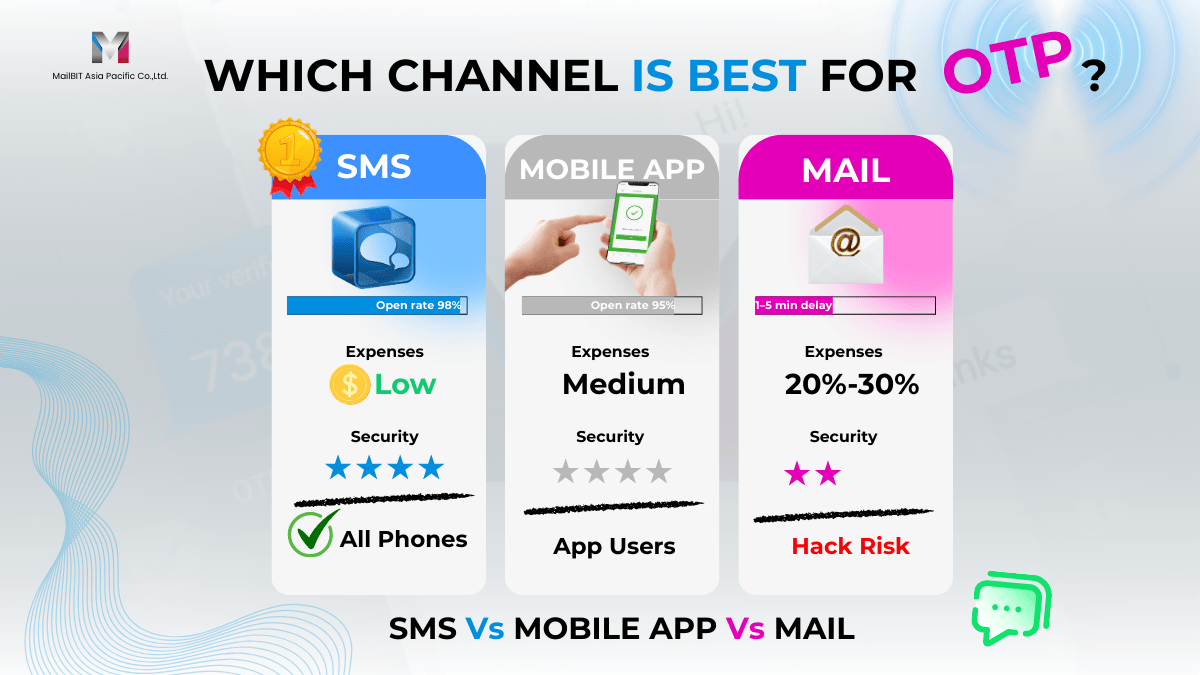
SMS OTP remains the most trusted authentication channel globally.
Why Businesses Prefer SMS:
- Works on all mobile phones
- No internet required
- 98% open rate
- Fast delivery (within seconds)
- Scalable for high-volume traffic
For enterprises that need guaranteed routing and licensed connectivity, consider using a 👉 high-performance SMS gateway designed for transactional traffic.
If your organization handles banking or financial transactions, deploying an 👉 enterprise messaging platform ensures compliance and high delivery success rates.
Businesses upgrading their authentication systems often choose a 👉 direct operator connection service to avoid grey routes and delays.
2️⃣ Mobile App OTP – Enhanced Security
App-based OTP (Push authentication or authenticator apps) provides a more secure authentication layer.
Benefits:
- Higher security than traditional SMS
- No SIM swap risk
- Seamless user experience
- Real-time approval
Companies that already operate mobile applications can integrate a 👉 multi-factor authentication system for stronger identity protection.
To optimize authentication flows, many enterprises deploy a 👉 scalable cloud communication API for secure app-based OTP verification.
3️⃣ Email OTP – Slower & Lower Security
Email OTP is commonly used but not ideal for mission-critical authentication.
Limitations:
- 1–5 minute delay
- 20–30% open rate
- Higher hack risk
- Spam filtering issues
If you are currently relying on email verification and facing delivery delays, upgrading to a 👉 real-time OTP delivery service can significantly improve login success rates.
Organizations seeking to reduce fraud exposure should consider migrating to a 👉 secure authentication messaging provider instead of relying solely on email.
Best OTP Strategy in 2026: Multi-Channel Delivery
The most secure and reliable strategy is not choosing one channel — but combining them.
Recommended Structure:
- Primary: SMS OTP
- Secondary: App-based OTP
- Backup: Email
To implement this efficiently, you need a 👉 multi-channel messaging solution that supports SMS, push notifications, and fallback routing.
Enterprises scaling across Southeast Asia often deploy a 👉 regional cloud messaging provider to ensure compliance and cross-border routing stability.
If your business handles high-volume transactions, integrating a 👉 high-capacity OTP infrastructure will protect both your users and your revenue.
Final Recommendation
If authentication speed, delivery rate, and fraud prevention matter to your organization, investing in a 👉 professional OTP delivery platform is no longer optional — it’s essential.
A modern 👉 enterprise-grade messaging gateway ensures:
- Faster OTP delivery
- Higher success rates
- Stronger compliance
- Lower fraud risk
- Better user experience
📱 LINE: @MailBIT
📞 Tel: +66 2-237-7778 | +66 81-300-0958 (Bangkok, Thailand)
#MailBIT #BulkSMS #OTPSMS #SMSGateway #CloudMessaging
#A2PMessaging #LINEOfficialNotification #BusinessSMS
#GlobalSMS #ThailandTech #EnterpriseMessaging #DigitalCommunication #SMSMarketing #TechCompany #MessagingSolutions #NBTC #SecureMessaging #APAC
#CPaaS #LocationBasedSMS