English
  ไทย
ไทย 

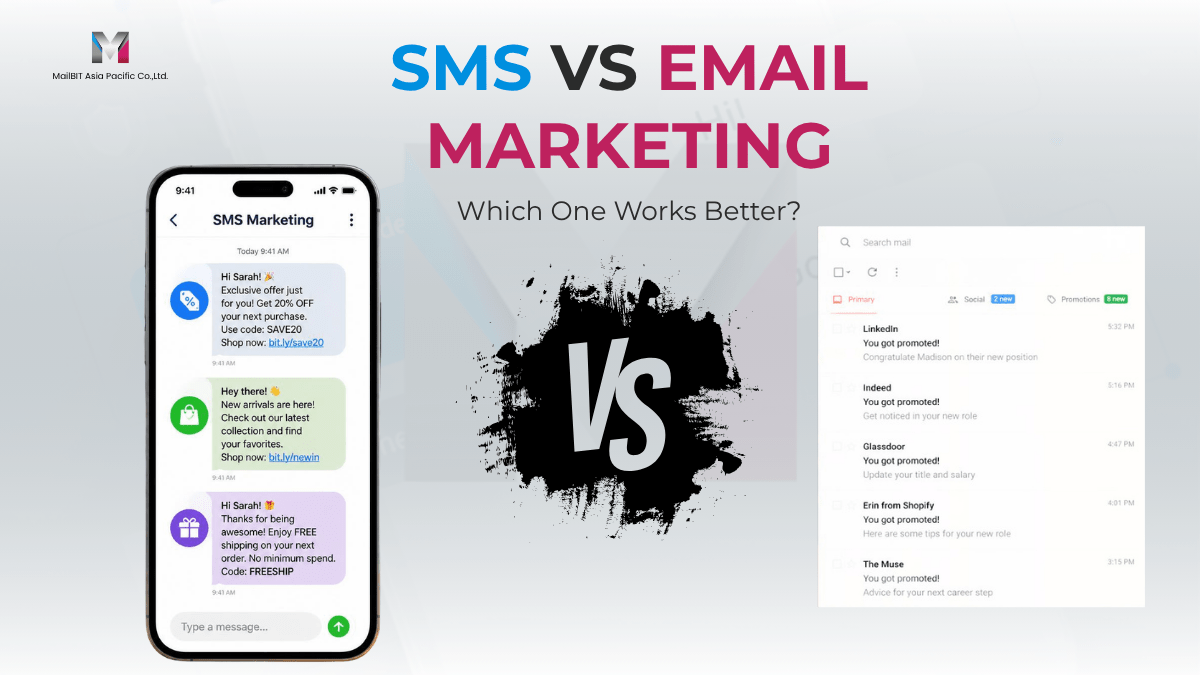
Digital communication plays an important role in helping businesses connect with customers. Two of the most widely used marketing channels are SMS Marketing and Email Marketing.
Both channels offer unique advantages. SMS is known for speed and direct communication, while email provides more space for detailed content, visuals, and long-form information.
So, which channel is better for your business?
The answer depends on your marketing goals, target audience, message type, and the customer experience you want to create.
What Is SMS Marketing?
SMS Marketing allows businesses to send promotional messages, special offers, updates, reminders, and important information directly to customers’ mobile phones.
Businesses commonly use Business SMS for:
- Promotional campaigns
- Limited-time offers
- Flash sales
- Appointment reminders
- Order updates
- Delivery notifications
- Customer alerts
- Event reminders
Because SMS messages are delivered directly to mobile devices, they are suitable for time-sensitive communication.
For example, a retail business may use Bulk SMS to announce a one-day promotion, while a service business may send appointment reminders to reduce missed bookings.
What Is Email Marketing?
Email marketing allows businesses to send detailed content directly to customers’ inboxes.
Email is commonly used for:
- Company newsletters
- Product information
- Long-form content
- Educational materials
- Business updates
- Customer onboarding
- Monthly promotions
Email can include images, buttons, product details, links, and longer messages. This makes it useful when businesses need to provide more information than a standard SMS message can contain.
SMS vs Email Marketing: Key Differences
1. Speed
SMS is designed for fast and direct communication.
Businesses can use an SMS Gateway to send important messages to customers quickly. This makes SMS suitable for urgent notifications, time-sensitive promotions, and immediate updates.
Email delivery can also be fast, but customers may not check their inboxes immediately.
Best for urgent communication: SMS
2. Message Length
SMS is short and direct. It works best when the message focuses on one clear action.
Email provides more space for detailed explanations, product descriptions, images, and multiple links.
Best for detailed information: Email
3. Customer Engagement
SMS appears directly on a customer’s mobile device, making it useful for immediate communication.
A well-planned SMS Marketing campaign can encourage customers to take action quickly, especially when the message includes a clear offer or call to action.
Email can support longer customer journeys by providing useful information over time.
Best for immediate action: SMS
4. Content Design
Email provides greater flexibility for visual design. Businesses can include:
- Product images
- Brand colors
- Marketing banners
- Multiple buttons
- Detailed content
SMS is more concise and focuses on delivering a clear message quickly.
Best for visual and detailed content: Email
5. Time-Sensitive Campaigns
For flash sales, limited-time promotions, urgent updates, or reminders, SMS can be highly effective.
Businesses can use SMS API to connect messaging services with websites, applications, CRM systems, and internal platforms.
Best for time-sensitive messages: SMS
When Should Your Business Use SMS?
SMS is suitable when your business needs to:
✅ Send urgent notifications
✅ Promote limited-time offers
✅ Announce flash sales
✅ Send appointment reminders
✅ Provide order or delivery updates
✅ Communicate quickly with customers
✅ Support real-time business notifications
A reliable SMS Gateway for Business can help businesses deliver messages efficiently while supporting high-volume communication.
When Should Your Business Use Email?
Email is suitable when your business needs to:
✅ Share detailed information
✅ Send newsletters
✅ Introduce products or services
✅ Provide educational content
✅ Build long-term customer relationships
✅ Create visually designed campaigns
Email is useful when customers need more information before making a decision.
Why Use SMS and Email Together?
SMS and email do not have to compete. In many marketing strategies, the two channels work better together.
For example:
📧 Send an email with complete product information.
📱 Follow up with an SMS reminder.
📧 Send a detailed campaign announcement.
📱 Use SMS to notify customers before the promotion ends.
📧 Share a monthly newsletter.
📱 Send important updates through Business SMS.
By combining both channels, businesses can provide detailed information through email while using SMS for fast and direct communication.
Choosing the Right Channel for Your Business
Before choosing SMS or email, consider:
- How urgent is the message?
- How much information needs to be included?
- What action should customers take?
- When do customers need to receive the message?
- Is the campaign promotional, informational, or transactional?
If your message is short and time-sensitive, SMS Marketing may be the right choice.
If your message requires detailed information and visual content, email may be more suitable.
For the strongest communication strategy, consider using both channels together.
Conclusion
SMS and email marketing each offer valuable benefits.
SMS is ideal for:
- Fast communication
- Urgent updates
- Limited-time promotions
- Reminders
- Direct customer engagement
Email is ideal for:
- Detailed information
- Newsletters
- Visual campaigns
- Long-form content
- Customer education
The best marketing strategy is not always choosing SMS over email. It is choosing the right channel for the right message.
With reliable SMS Marketing, scalable Bulk SMS, and efficient SMS API integration, businesses can create faster and more effective customer communication.
📱 LINE: @MailBIT
📞 Tel: +66 2-237-7778 | +66 81-300-0958 (Bangkok/Thailand)
🌐 www.mailbit.co.th
#MailBIT #PromotionSMS #SMSMarketing #BulkSMS #SMSAPI #SMSGateway #BusinessSMS #DigitalMarketing #CustomerEngagement #EnterpriseSMS