English
  ไทย
ไทย 

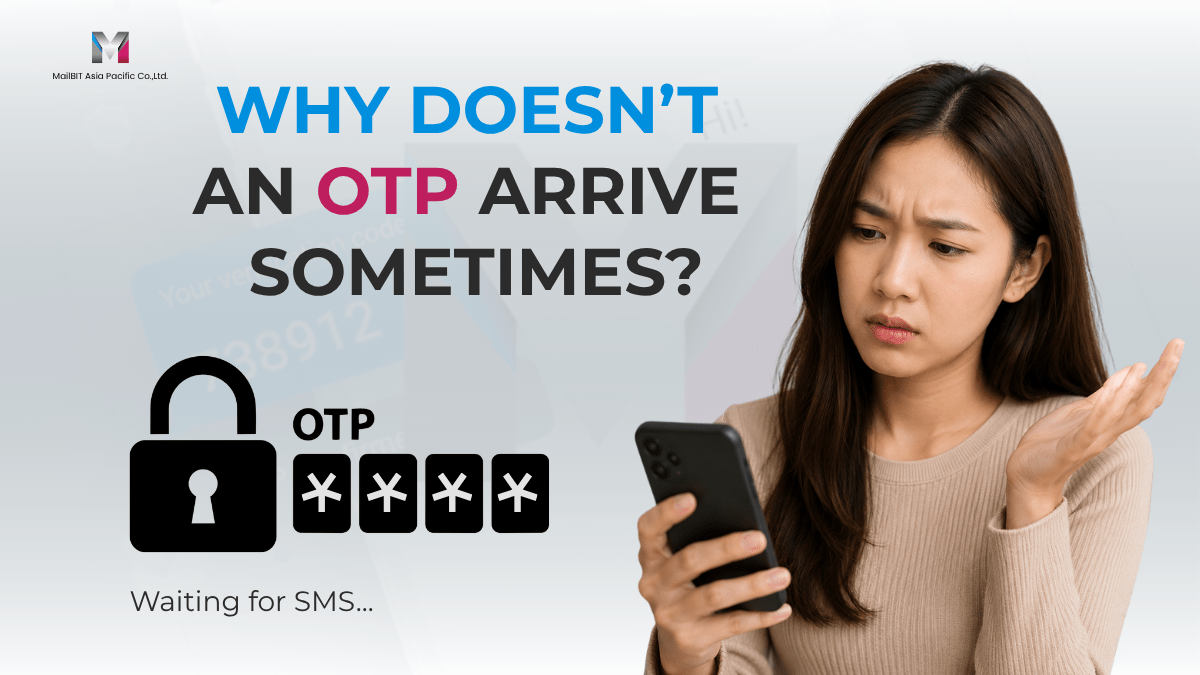
In today’s digital world, SMS OTP plays an important role in secure user authentication. Businesses use OTPs to verify phone numbers, protect user accounts, reset passwords, confirm transactions, and provide secure access to websites and mobile applications.
However, users may sometimes experience issues such as:
“Why hasn’t my OTP arrived?”
“I requested a new OTP, but I still haven’t received the SMS.”
“The OTP arrived too late and had already expired.”
An OTP delivery issue does not always mean that the business system has failed. An OTP message passes through several stages, including the business application, the SMS API, the SMS Gateway, mobile network infrastructure, and the recipient’s device.
Understanding these possible causes can help businesses improve OTP delivery performance and create a smoother user experience.
What Is an OTP and Why Is Fast Delivery Important?
OTP stands for One-Time Password. It is a temporary security code that can be used only once and is typically delivered through an OTP SMS service.
Businesses commonly use OTPs for:
- Website and application login
- User registration
- Mobile number verification
- Password resets
- Online transaction confirmation
- Account security
- Payment verification
- Two-factor authentication
Because OTP codes are usually valid for a limited period, delivery speed is essential. If an OTP arrives late, the code may expire before the user can enter it. This may lead to repeated OTP requests, failed login attempts, and customer frustration.
1. Weak or Unstable Mobile Network Signals
A weak mobile signal is one of the most common reasons why an OTP may arrive late.
Users may experience delayed SMS delivery when they are:
- Inside large buildings
- In basements
- Inside elevators
- In remote areas
- In locations with limited mobile coverage
A phone may also be turned off, set to Airplane Mode, or temporarily disconnected from the mobile network.
In these situations, the SMS Gateway Thailand may have already submitted the message, but the mobile network may not be able to deliver it to the device immediately.
2. Incorrect or Invalid Phone Numbers
An OTP cannot be delivered if the phone number is incorrect, incomplete, or stored in an unsupported format.
Businesses should validate:
- The correct number of digits
- Mobile number format
- Country code
- Leading zero requirements
- Duplicate or invalid phone number records
Using a reliable SMS API Integration can help businesses validate and process phone numbers before sending OTP messages.
3. Device Settings or SMS Storage Issues
In some cases, the issue may be related to the recipient’s mobile device.
Possible causes include:
- SMS messages being blocked
- Spam filtering settings
- Messaging application errors
- Limited device storage
- Outdated device software
Users may try restarting their phones, checking blocked-message settings, or confirming that their messaging application is working correctly.
If other phone numbers can receive the OTP message but one specific device cannot, the issue may be related to the device or its settings.
4. SMS Messages May Be Filtered or Blocked
Mobile devices and network operators may use automated systems to identify suspicious or unwanted messages.
Messages may be filtered when they contain unusual formatting, unclear sender information, or content that appears similar to spam.
Businesses can help reduce this risk by:
- Using a clear and recognizable Sender ID
- Registering the Sender ID according to applicable requirements
- Keeping OTP messages concise and easy to understand
- Avoiding unnecessary promotional content in authentication messages
- Using a reliable Business SMS platform
A recognizable SMS Sender ID can also improve customer trust by making it clear which organization sent the message.
5. High OTP Request Volumes
During peak periods, a website or application may receive a large number of OTP requests at the same time.
This may happen during:
- Major sales campaigns
- Product launches
- High-traffic events
- Promotional periods
- Large user registrations
- System-wide login activity
If the system is not designed to manage high message volumes, OTP delivery may be delayed.
Possible issues include:
- Increased message queues
- Slow system response times
- Multiple OTP requests from the same user
- Duplicate OTP messages
- Delayed processing
A scalable Bulk SMS service can help businesses manage high-volume messaging more efficiently.
6. SMS Delivery Routes Can Affect Speed and Reliability
The quality of the SMS delivery route can affect how quickly and consistently OTP messages reach users.
Businesses that rely on OTP authentication should consider an Enterprise SMS Solution designed for reliable, high-volume messaging.
This is especially important for:
- Banks and financial institutions
- FinTech platforms
- E-commerce businesses
- Mobile applications
- Membership systems
- Online marketplaces
- Digital service platforms
For these businesses, delayed OTP delivery may interrupt login processes, prevent transactions, and affect customer confidence.
7. Website, Application, or API Issues
Sometimes, the OTP delivery problem may occur before the SMS message reaches the messaging provider.
Possible issues include:
- OTP generation errors
- Website or application downtime
- API connection failures
- Database delays
- Incorrect API configuration
- Failed message requests
Businesses should monitor the complete delivery process and confirm:
- Was the OTP generated successfully?
- Was the request sent to the SMS Platform?
- Did the SMS provider receive the request?
- Was the message accepted for delivery?
- What is the final delivery status?
A reliable SMS API with delivery reporting can help technical teams identify where an issue occurred and respond more efficiently.
How Can Businesses Reduce OTP Delivery Problems?
Businesses can improve OTP delivery performance by following these best practices:
- Choose a stable and reliable SMS service
- Validate phone numbers before sending OTPs
- Use a clear and approved Sender ID
- Integrate with a secure SMS API
- Monitor message delivery status in real time
- Design systems to support high user volumes
- Prevent excessive OTP requests
- Apply appropriate resend intervals
- Avoid sending multiple OTPs within a short period
- Set up alerts for delivery or system issues
- Use a scalable Cloud Messaging Platform
Why Should Businesses Choose a Reliable SMS OTP Solution?
For businesses that send large volumes of OTP messages, speed alone is not enough. An effective OTP solution should also provide reliability, security, scalability, and visibility into message delivery.
A professional SMS OTP solution from MailBIT helps businesses support secure authentication workflows while integrating messaging directly into websites, applications, and business systems.
Suitable use cases include:
- Websites and web applications
- Mobile applications
- E-commerce platforms
- FinTech services
- Membership systems
- Online booking platforms
- Customer portals
- Digital identity verification systems
Conclusion
An OTP may fail to arrive or experience delays for several reasons, including weak mobile signals, incorrect phone numbers, device settings, message filtering, high request volumes, delivery route limitations, or issues within the website or application.
By using a reliable SMS OTP service, a stable SMS Gateway, and a well-integrated SMS API, businesses can improve authentication workflows, reduce OTP delivery issues, and provide a smoother experience for users.
If your business is looking for a reliable SMS Gateway for Business, explore Bulk SMS, OTP SMS, Business SMS, and SMS API solutions from MailBIT to find the right messaging solution for your organization.
📱 LINE: @MailBIT
📞 Tel: +66 2-237-7778 | +66 81-300-0958 (Bangkok/Thailand)
🌐 www.mailbit.co.th
#MailBIT #PromotionSMS #SMSMarketing #BulkSMS #SMSAPI #SMSGateway #BusinessSMS #DigitalMarketing #CustomerEngagement #EnterpriseSMS